
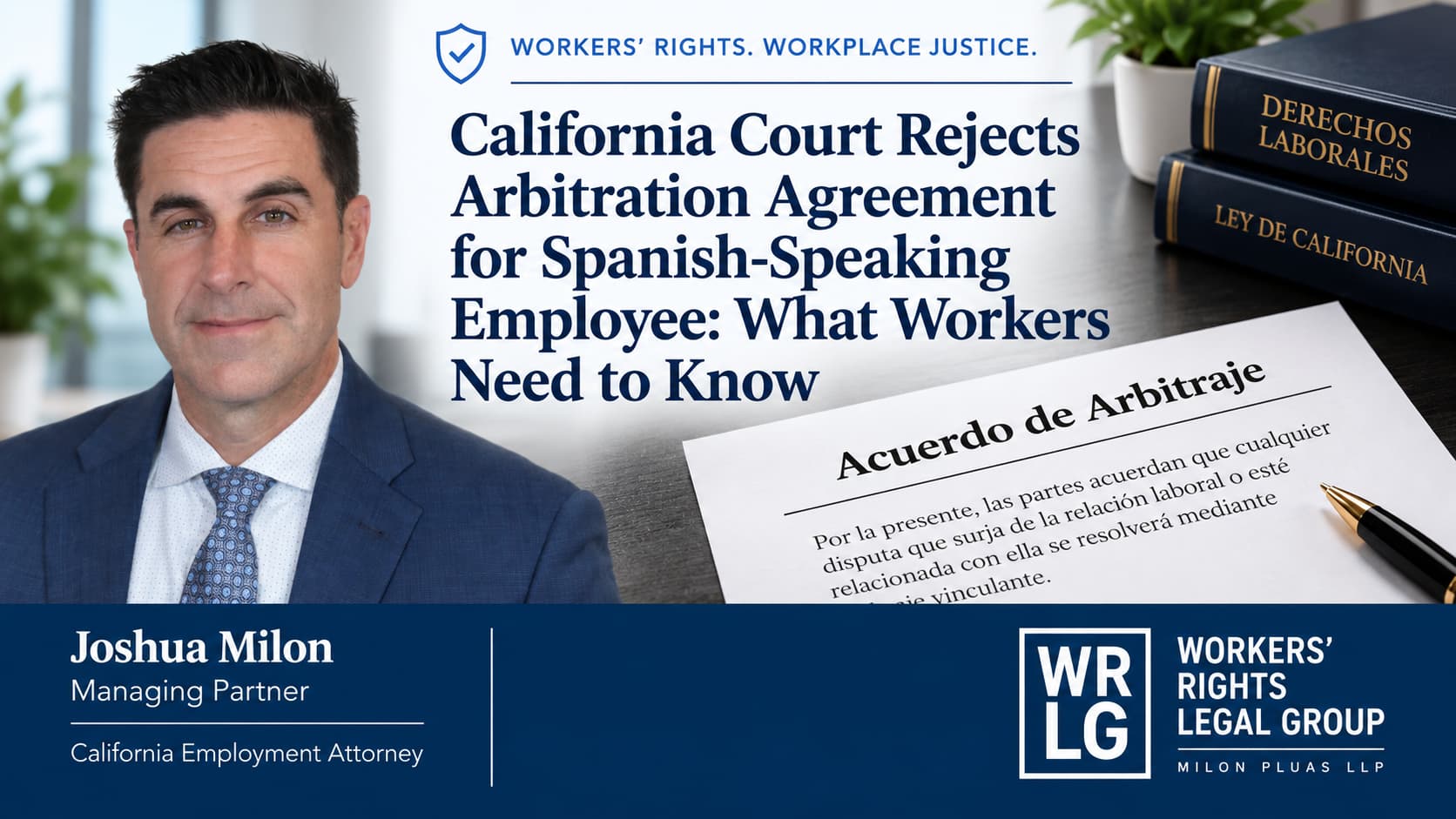

California Court Rejects Arbitration Agreement for Spanish-Speaking Employee: What Workers Need to Know
By Joshua Milon, Workers’ Rights Legal Group A California trial court recently denied an employer’s motion to compel arbitration in an employment case involving a Spanish-speaking worker who was never given documents in his language and was not meaningfully informed of what he was signing. The decision reflects a broader shift in how California courts evaluate arbitration agreements, moving beyond whether a signature exists and toward whether the employee genuinely understood the rights they were asked to waive. This article explains what happened, why it matters, and what employees should know if they have questions about an arbitration agreement they signed during onboarding.What the Court Decided and Why
The Orange County Superior Court denied the employer’s motion to compel arbitration on two independent grounds. First, the employer failed to prove the electronic signature was actually made by the employee. Second, the court found fraud in the execution, meaning the agreement was void from the start because the employee did not understand its nature.“Companies should no longer treat arbitration agreements as routine onboarding documents. The courts are not only asking whether the employee actually signed and assented to the agreement, they are also applying more scrutiny on the employers to provide verifiable details of the onboarding process. That shift is fundamentally changing how these cases are evaluated.” – Joshua Milon, Workers’ Rights Legal Group
What this means for employees
- An electronic signature alone does not guarantee an arbitration agreement is enforceable
- Language barriers can be the basis for challenging an agreement entirely
- Courts are looking at what actually happened during onboarding, not just what was signed
What this means for employers
- Onboarding platforms must produce employee-specific evidence, not just system descriptions
- Refusing to provide translated documents creates serious legal risk
- Arbitration agreements that are void cannot be enforced, even in appellate proceedings
The Authentication Problem: When a Signature Is Not Enough
The employer relied on a third-party digital onboarding platform called TalentReef and submitted declarations describing how its system works. The court found this was not enough. There was no evidence the employee created or accessed a TalentReef account on the relevant date. The agreement contained no IP address linking the signature to the employee. No unique identifiers such as an email address or employee ID connected the signature to this individual. There was also no evidence the employee consented to electronic signature procedures.“Employers often rely on company-level descriptions of their onboarding platforms, but courts are increasingly requiring employee-specific evidence. Without specific data tying a particular individual to a particular electronic signature, those agreements are vulnerable to challenge at the outset.” – Joshua Milon, Workers’ Rights Legal Group
What courts are now requiring employers to show
- That the specific employee accessed the onboarding system
- That the specific employee reviewed the relevant documents
- That the specific employee consented to electronic signature procedures
- That the specific employee executed the specific agreement at issue
Fraud in the Execution: When an Agreement Is Void From the Start
Even setting aside the authentication issue, the court found the agreement was void due to fraud in the execution. This is a distinct and powerful legal doctrine. The employee primarily read and wrote in Spanish. When he requested translated documents, he was told they were only available in English. He was not permitted to take documents home for review or consult with anyone. He was not given a meaningful explanation of the arbitration provision. He was told the documents related only to anti-harassment policy, drug policy, and tax forms. Given these circumstances, the court found he did not understand the fundamental nature of what he signed. When fraud in the execution is established, the agreement is void, not merely unenforceable. This means the case remains in court entirely.The Najarro Framework and Its Growing Influence
The court relied on Najarro v. Superior Court (2021) 70 Cal. App. 5th 871, a case litigated by Workers’ Rights Legal Group. That decision established that fraud in the execution occurs when an employee is deceived as to the nature of what they are signing and does not understand the fundamental character of the agreement. The recent Orange County ruling demonstrates that this framework continues to shape how California courts evaluate arbitration agreements involving language access and employer control over information. If you were rushed through onboarding in a language you do not read, denied the chance to review documents carefully, or told that what you were signing was something other than an arbitration agreement, you may have grounds to challenge it.Factors courts consider under the Najarro framework
- Whether the employee could read the language the document was written in
- Whether the employer refused to provide a translation when asked
- Whether the employee was given time to review or consult with someone
- Whether the employer misrepresented what the documents contained
- Whether the employee reasonably relied on the employer’s description
Language Access as a Legal Issue, Not Just a Practical One
California has a large workforce in which many employees are not fluent in English. When employers provide critical employment documents only in English and deny translation requests, courts may find that no valid agreement was ever formed. This is especially significant for arbitration agreements, which ask employees to give up their constitutional right to a jury trial. The failure to ensure that a non-English-speaking employee understood that waiver is not a technicality. It goes to the core of whether any agreement existed.What to Do If You Think Your Arbitration Agreement Was Invalid
If you signed an arbitration agreement during onboarding and any of the following apply, you should speak with an employment attorney:Situations worth reviewing
- You primarily read a language other than English and were not given a translated document
- You were told to sign quickly without time to read or ask questions
- You were not told you were signing an arbitration agreement
- You signed through an online system but have no record of doing so
- You were given no explanation of what rights you were waiving
The facts of your situation will determine whether a challenge is viable. This article provides general legal information and is not legal advice.
Independent legal analysis from Lex Wire Journal — This article is based in part on an in-depth analysis published by Lex Wire Journal, an independent legal media platform that covers developments in California employment law. Read the full Lex Wire Journal analysis: California Trial Court Rejects Arbitration Agreement Applying Najarro Framework
Related Employment Law Articles
- The Evolution of Employee Rights in California Employment Law
- California Employee Rights in Wrongful Termination Cases: 2025 Legal Update
Talk to Workers’ Rights Legal Group
If you signed an arbitration agreement and believe you may have grounds to challenge it, our team can review your situation and help you understand your options. Request a Confidential Consultation | Call NowReplace contact links and phone number with your live site information.
This article provides general legal information and is not legal advice. Every case depends on its unique facts.

About the Author
Joshua Milon, Managing Partner at Workers’ Rights Legal Group, is a California employment attorney (State Bar No. 245287). Born and raised in Southern California, Joshua earned his undergraduate degree from the University of California Santa Barbara, where he double majored in Business Economics and Psychology. He later attended Southwestern University School of Law in Los Angeles.California State Bar Profile (No. 245287): View Joshua Milon’s Attorney Profile on the State Bar of California
Joshua’s Linkedin Profile: View Joshua’s Linkedin Profile